Case study
Spark
A card game an older adult designs the rules for, and their grandchild has to follow.
Case study
A facilitated session where an older adult and a younger relative design a card game together — and the older adult writes the rules.
Three-person team · Design for Dignity (ARTG5710), Northeastern · Service design: research, personas, journey, blueprint, system map
The problem, read differently
The standard framing is that older adults need to be taught technology. The research supports a version of that: across the barriers people report, cost dominates for adults in their late fifties and knowledge dominates by eighty and over — the two invert with age, so whatever is going wrong is not one problem with one fix.
But sitting under it is a different reading, and it is the one the whole project turns on. Margaret does not feel excluded from her phone. She feels excluded from the moments that happen around it — the group chat where the trip gets planned, the meme everyone else laughs at, the reference she cannot place. She wants to be in those conversations, not a simplified version of them. Not a watered-down grandma edition. The real ones.
Read that way, this stops being a usability problem. Every tutorial ever written assumes the goal is competence. The actual goal is standing — and you cannot instruct someone into standing.
Constraints
- The design had to work for someone who owns one device they did not choose. Margaret’s iPhone was a gift from her daughter; the interaction vocabulary available is phone calls and basic texts.
- No downloads, no new hardware, no account. Anything requiring setup reintroduces the dependency the project exists to remove.
- A ninety-minute session, free, all skill levels. That is the whole window in which the dynamic has to change.
- Two people who love each other and are both slightly ashamed — she of forgetting, he or she of being impatient. Any design that made either feel worse would fail on contact.
- Secondary research only. We had published survey data, not access to older adults.
What informed the design
- Published survey data on technology barriers among older adults: McKinsey via Statista on the cost-versus-knowledge split by age band, Pew on adoption, and AARP’s finding that a large share of older adults feel technology simply is not designed for them. That last one reframed the brief — if the tools were never designed with them, this is a co-design failure rather than a usability failure.
- Two personas we wrote from that data — Margaret, 72, a retired teacher, and Emma, 19, a communication student who visits monthly. They are constructed, not interviewed, and the case study treats them as design instruments rather than evidence. Their value is that they name the same failure from both ends: “I don’t want to keep asking Emma to show me again. She’s busy and I can see it on her face” against “I show her three times and she still can’t do it. I don’t know if I’m just bad at explaining.” Nobody in that pair is the problem.
- Tover, whose “purposeful play” work builds warm technology for the care sector, as the nearest precedent for treating play rather than instruction as the vehicle.
- Uno and Codenames, cited in our own research board as the model for the affordance we needed: simple enough rules that an older adult is never lost, deep enough that a nineteen-year-old does not feel they are doing a kindergarten activity. That single sentence is why the artifact is a card game.
- A fifteen-stage journey structure, used to force the question of what happens after the session ends — which is where most workshop-shaped interventions quietly stop.
What we rejected
Teaching. The obvious intervention is a better tutorial: clearer steps, larger type, more patience. We ruled it out because it cannot fix the thing that is actually wrong. A tutorial, however kind, restates the hierarchy — one person knows, one person does not. Margaret’s problem is not that the instructions were unclear. It is that she has been on the receiving end of other people’s systems long enough to stop expecting a role in them.
A creative-software learning toolkit. One of the three directions we took into the research phase was a gamified toolkit for designers learning Procreate — skills as chapters of a narrative rather than documentation, on the reasoning that you should progress at your own pace through a story rather than a test. The dignity logic was sound and the audience was wrong: designers learning a drawing app are inconvenienced, not excluded. We moved to the direction where the stakes were someone’s place in their own family.
A “grandma edition”. Simplifying the thing everyone else uses produces a second-class version of belonging, which is the opposite of the goal.
An app. For a project titled digital co-design, the artifact is a printed card deck. Anything with a download and a login puts a setup step between two people in a room, and the setup step is exactly where the dependency reappears.
Measuring success by capability. The tempting metric is whether Margaret can FaceTime her grandkids at the end. We rejected it. Success is whether the two of them leave with a shared ritual they can return to on their own — one she feels entitled to start.
Key design decisions
The elder authors the rules. The facilitator opens with a question only the older adult can answer: what is something you know a lot about that Emma probably doesn’t? Whatever comes back becomes the game’s subject matter. Emma contributes structure, but Margaret approves every decision, and if a suggestion makes her hesitate it does not make the cut. This is the merit pillar doing structural work rather than sitting in a values statement: her knowledge is not honoured symbolically, it is the raw material the artifact is built from. It also solves the practical problem — she can never be lost in a game whose rules she wrote.
Three parameters instead of a specification. The pair do not need to know what the game will be before they start, only what it must feel like: meaningful to Margaret, requiring genuine participation from both, and never putting either of them in a position where they feel useless. When both can say yes to all three, it is ready. Constraints on the feel rather than the form leave the authorship where it belongs.
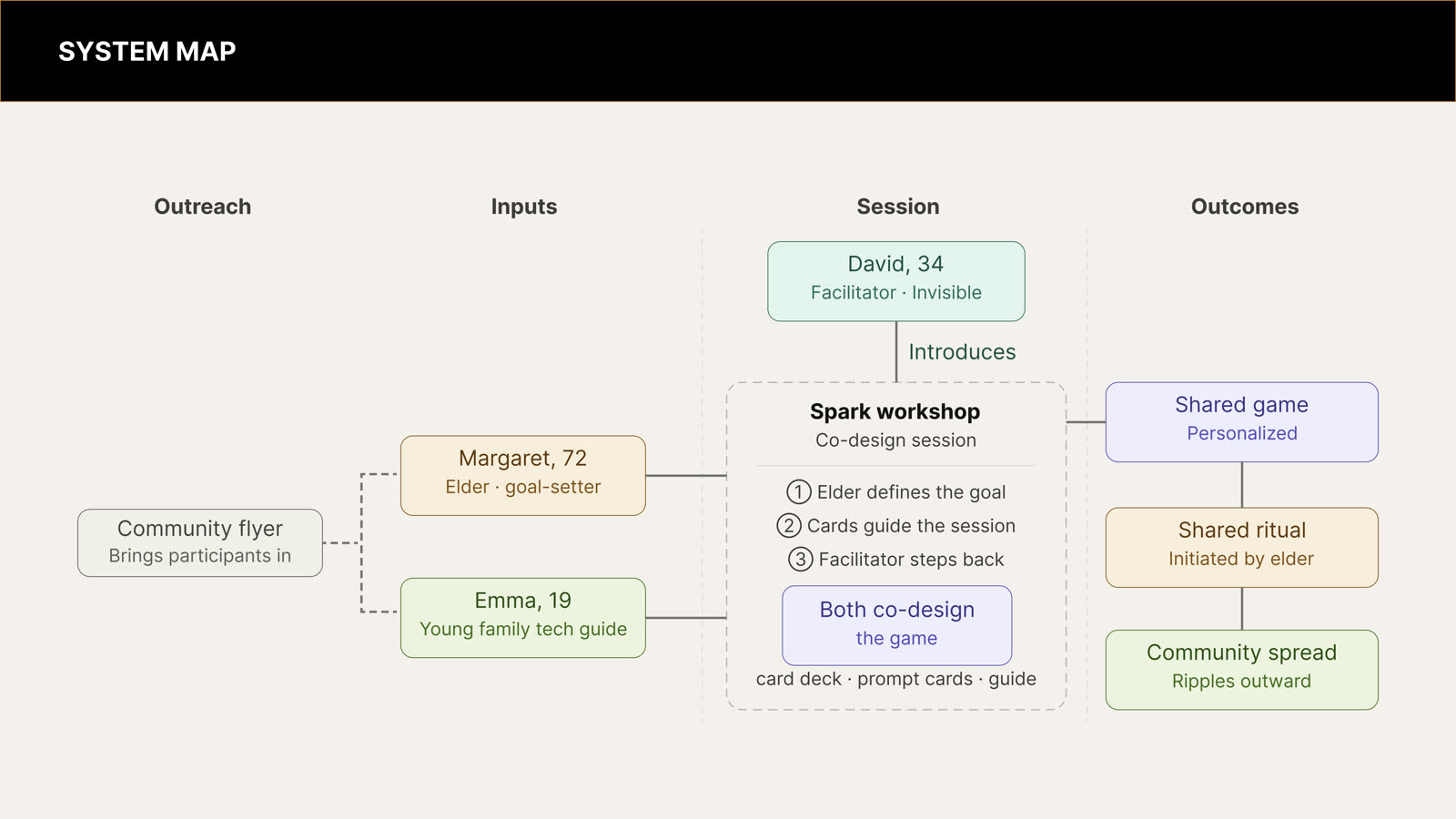
The facilitator is designed to disappear. David hands over a card reading Elder Expert and steps back. He holds the framework silently, redirects Emma if she takes over, and intervenes only if someone is uncomfortable. Across the ten-panel storyboard he is present at the door, visible in the background with folded arms while they build, out of frame while they play, and gone by the time the cheat sheet goes on the fridge. A facilitator whose success is measured by how little he is needed at the end is the argument in miniature.
The take-home is in her handwriting. The session ends with a cheat sheet she wrote, a deck of cards, and blank sheets. The reason it is handwritten rather than printed is the whole point: a printed summary is something she was given, and a handwritten one is something she made.
Accessibility as a build constraint. The palette was checked for WCAG AA contrast with high-contrast pairings specified for low-vision users, the flyer is one page in large print, and the facilitator guide carries a dignity-first language guide alongside large-print and voice options. For an intervention aimed at people in their seventies and eighties, legibility is not a finishing pass.
The result
The system is a loop rather than a workshop. A flyer that asks what someone wants rather than what they need — bring a phone, bring someone you love — brings a pair in. Role cards assign Elder Expert and Tech Guide. Prompt decks across travel, food, memory, values and creative give the session somewhere to start. The pair co-design, then play. They leave with the game.
Then the part most service designs skip: she initiates the next one. She tells her daughter, animated, about what she contributed and how Emma did not know half the answers. Her neighbour asks how to sign up. Her word-of-mouth loops back into the outreach that brought her in, which means the system’s distribution channel is the people it already served — not because they were asked to advocate, but because they have something they are proud of.
Outcome
This is a designed service, not a run one. It exists as secondary research, two personas, a fifteen-stage journey map, a ten-panel storyboard, a six-phase service blueprint, a three-layer system map, and a full set of collateral specifications. No session has been facilitated, no older adult has held the Elder Expert card, and nothing here has met a real pair of people.
That boundary matters, because the design makes a claim about how two people will feel — and feelings are exactly what a blueprint cannot verify. What the project does establish is a coherent system with an explicit theory of why existing interventions fail and a mechanism aimed at that cause rather than its symptoms.
What I’d change
Run it once. Every claim in this project is a hypothesis about a room, and one facilitated session with a real pair would either validate the handover or expose it immediately. The most likely failure is the moment the card changes hands: an older adult handed authority she did not ask for may simply hand it straight back.
Design for the pair who do not get along. The storyboard assumes affection and mild guilt. Some intergenerational pairs bring resentment, and the design has no answer for a session where the elder does not want to be the expert.
Give the facilitator less to hold. David’s disappearance is the mechanism, and it currently depends on his judgment — knowing when to redirect without taking over. That is a lot to ask of training. The more robust version puts more of that logic into the cards, where it cannot be forgotten under pressure.
Documents
- Final presentation The service blueprint, the framework, and the prompt decks.
- Hero’s journey map Fifteen stages, the ten-panel storyboard, and the three-layer system map, with the dignity pillars marked where each one activates.
- Intervention Secondary research, both personas, the design identity, and the perception-gap argument.
- Arrangement The journey map and storyboard as presented.
- Research The opening brainstorm and the three directions we started from.